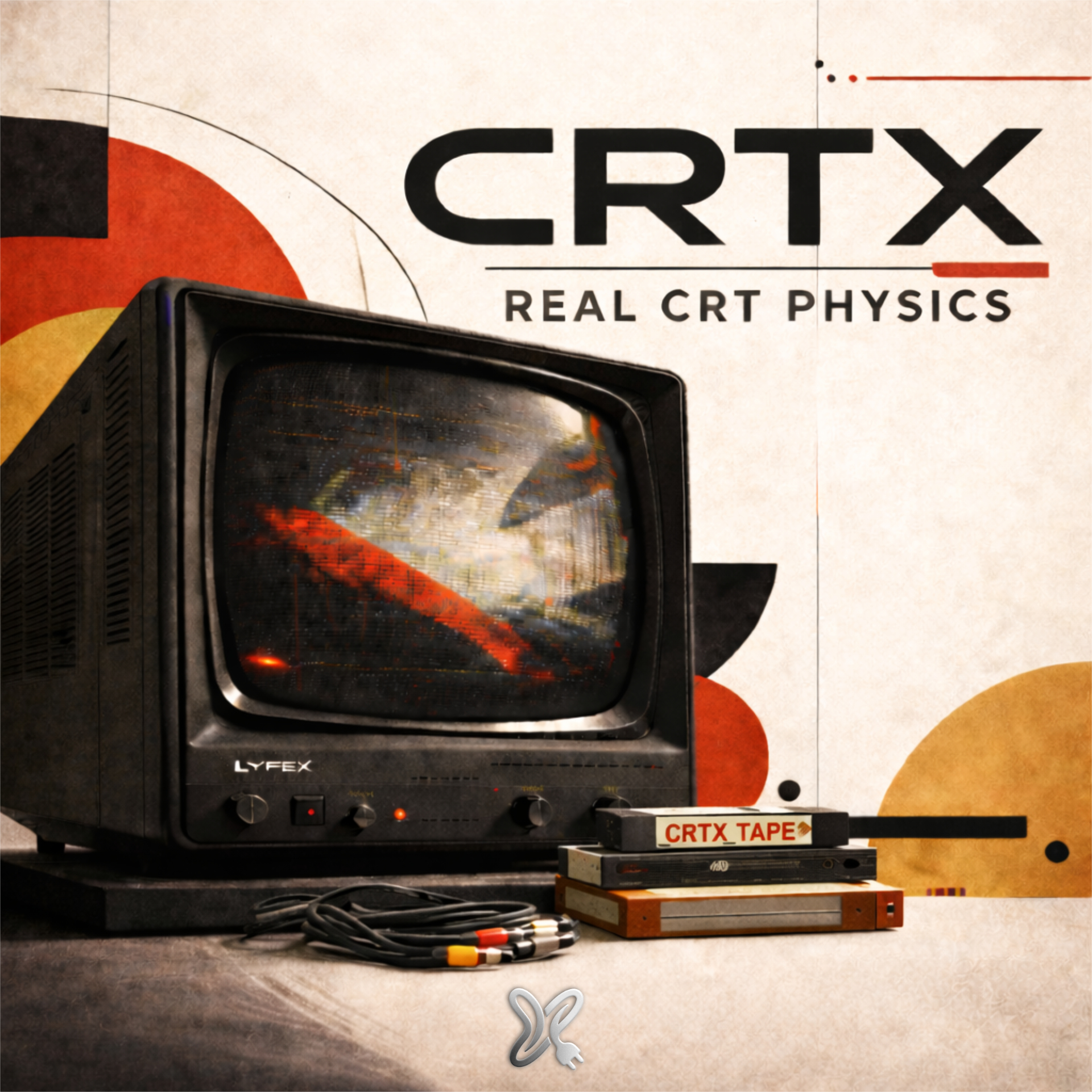
CRTX is a step beyond CRT simulation. Every frame gets redrawn like a real beam is painting it, with scan structure, mask patterns, bloom, glow, analog signal chaos, and controllable instability reacting to motion, luminance, and edges.
Licensing, downloads, and updates are handled through aescripts for this release.
CRTX
Real CRT physics for After Effects and Premiere Pro.
Beam bloom, phosphor persistence, scan structure, glass haze, and analog instability are fused to the source, not layered over it. Highlights breathe, colors smear, and sync tears when you ask for them. Premiere Pro support, 150+ presets, GPU acceleration, and RF, Composite, S-Video, and RGB signal paths keep the look fast and art-directable.
How is CRTX licensed?
CRTX uses aescripts licensing. Purchase, downloads, and license codes are handled through your aescripts account.
How do updates work?
Updates are delivered through aescripts. Current public version is v1.2.1, which adds Vertical Blank and Horizontal Blank controls and fixes Premiere Pro activation.
What hosts are supported?
After Effects and Premiere Pro 2026, 2025, 2024, 2023, 2022, 2021, 2020, CC 2019, CC 2018, CC 2017, CC 2015.3, CC 2015, CC 2014, CC, and CS6.
Is it GPU accelerated?
Yes. GPU is recommended for the fastest previews and the most realistic results, though CPU mode is still available when needed.
Beam & Structure
Shape the electron beam and phosphor mask that make CRT images feel real.
Signal, Tube & Instability
Build authentic analog behavior and shape how the display reacts under load.
Analog Damage
Everything that makes analog video feel alive.
Performance & Hardware
Display models, surface response, and a faster workflow for look development.